
Emotional Invalidation in Asian Families: Provisional Psychologist Larissa Qiu on BPD, Culture, and Boundaries
Nov 25, 2025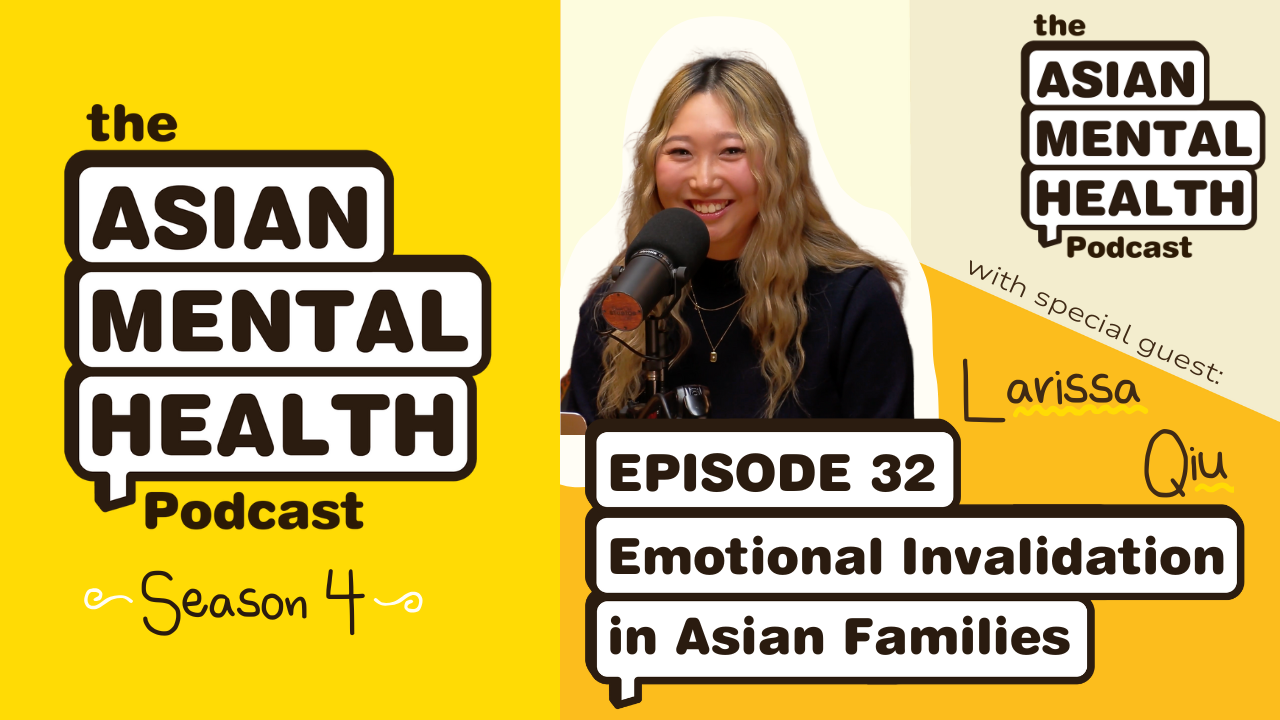
🎁 Free Resource: For further growth and learning, download "Working with Invalidation in Asian Families" → HERE
What happens when love is expressed through sacrifice, but not emotional presence? In this episode of the Asian Mental Health Podcast, Asami sits down with Larissa Qiu, a first-generation Chinese international student, provisional psychologist, and PhD candidate at Monash University, to unpack the hidden impact of emotional invalidation in Asian families.
Larissa shares candidly about growing up in an emotionally restrained household, the challenges of moving to Australia at 16, and her lived experience with borderline personality disorder (BPD) symptoms.
This conversation offers crucial insights for Asian Australians navigating cultural expectations and mental health, especially from a research perspective too.
🎧 You'll hear about:
✅ Why emotional invalidation is normalised in Asian families and why it still causes harm
✅ The fine line between cultural resilience and cultural silence
✅ Growing up as a "1.5-generation" migrant balancing Chinese and Australian identities
✅ The stigma surrounding borderline personality disorder (BPD) in Asian communities
✅ What healing looks like through culturally responsive therapy and supportive relationships
✅ Practical ways to set boundaries and seek validation, even when family can't provide it
Watch the episode below or find us on Spotify or Apple Podcasts!
💡 Episode Highlights:
- Growing up in an emotionally restrained Chinese household and moving to Melbourne as an international student
- How "be tough" messaging impacts mental health in Asian communities
- Understanding borderline personality disorder through a cultural lens
- The unique challenges of 1.5-generation migrants navigating two cultural identities
- Why material support isn't the same as emotional validation
- Finding culturally competent psychologists who understand Asian family dynamics
- Recovery strategies and self-validation techniques for Asian Australians
- Research insights from Monash's Culture, Trauma and Mental Health Research Group
🧠 Key Takeaways from Larissa:
"Invalidation in Asian families isn't about lack of love - it's often about survival strategies passed down through generations."
"As a 1.5-generation migrant, you're constantly translating - not just language, but emotions, expectations, and identities."
"BPD is so stigmatised, especially in Asian communities. But with the right support and cultural understanding, healing is possible."
"You can honour your culture while still needing emotional validation. Those two things aren't in conflict."
👤 About the Guest
Larissa Qiu is a first-generation Chinese international student, provisional psychologist, and PhD candidate at Monash University specialising in culture, trauma, and mental health. Based in Melbourne, Larissa brings both lived experience and professional expertise to understanding how cultural factors impact mental health in Asian Australian communities. Her research focuses on culturally responsive approaches to supporting diverse populations.
🔗 Monash Culture, Trauma and Mental Health Research Group
Why listen?
- If you've ever felt dismissed or told to "be tough": You'll find strategies for recovery and self-validation
- Parents: Gain perspective on how to provide both material and emotional support to your children
- Mental health practitioners: Hear directly from lived experience to better support culturally diverse clients
- International students: Learn how to navigate mental health support in Australia's system
🙌 Connect with Shapes and Sounds
✨ If you enjoyed this episode, please subscribe, rate, and review the Asian Mental Health Podcast. It helps more Asian Australians and international students find culturally responsive mental health support. Share it with a friend. Conversations like these help destigmatise mental health in Asian communities. 💛
~
Transcript
Hi everyone,
Today we’re talking with my PhD supervisee, Larissa Qiu - can you believe I’m a phd supervisor?
Anyway, Larissa is a first-generation Chinese international student and provisional psychologist training in the Clinical Psychology PhD program at Monash University.
Larissa’s story dives into how being invalidated by your parents can be harmful.. So, not abuse in the sense of physical or verbal harm, but what happens to your mental health when you’re ignored, or neglected, especially as a child?
In our chat, we tackle two big questions:
Should we accept invalidation as a cultural norm of Asian Cultures?
Or, is it harmful to our development and something that needs to be addressed?
For Larissa, invalidation contributed to her experience of Borderline personality disorder, which you’ll hear can be really damaging for relationships, work, anything really.
But you’ll hear straight away, Larissa’s an incredible researcher working at Monash, and just a fun and charming person, and she’ll share how she overcame some really big challenges in her life to get to where she is today. I learned a lot from this conversation and I know you’ll learn some really great strategies to help you work through some childhood pain and for the parents out there, perhaps learn some parenting tips too.
~
Asami: Hi, Larissa. Thank you so much for being here with us today. Thanks for having me. And Larissa, OK, I know a lot about your research, but people listening don't know about your research in a nutshell. Could you just help us to understand? What are you researching?
Larissa: So, for the last couple of years, I've been working at the Culture Trauma and Mental health Research Group at Monash university. And our research group looks at cultural differences in mental health. And we look into culture differences, mostly between Chinese Australian and European Australians. And this year I've started my own PhD and I'm really hoping to look into how invalidating environment impacts the emotional wellbeing of East Asian individuals.
Asami: Okay, so in validating environments, how that impacts East Asian people as they're growing up.
Larissa: Yeah, and how is that sort of difference from what the Western conceptualizations of invalidating environments look like?
Asami: Okay, okay. We're going to get into all of this, but paint me a picture. So let's start right from the start. If you go back to your childhood, like, what are some of the experiences that you define as invalidating for you?
Larissa: Yeah, so when I think back to my childhood, I think about my schools and my parents.
MX in - Lonely Low
I went to boarding school since year one and I went back home every weekend and boarding school in my area is sort of like a private school. So it's not exactly free education. My parents work really hard to sort of provide us with food, shelter, education. But school was really stressful always. And I think my parents spend a lot of time and energy focusing on building their business in order to be able to provide our family with a good life, but they never really pay attention to my feelings, my needs, my wellbeing growing up.
My parents took academic achievements quite seriously, but, they didn't really engage beyond that. For example, one of my childhood friends used to get sent to weekend tutoring school every weekend for at least like one day a week. And I thought to myself, thank God my parents didn't do that. But then I also thought, wow, but at least her parents actually seems to care.
In my family dynamics, the environments was quite like emotionally restrained. It wasn't a place where my experiences and my emotions were really talked about or seen. When I'm upset, I always have to try my best to suppress that, hide it without physically making it visible. Because when I actually cry, my parents would be like, what's the big deal? Why are you crying over such small things?
And another example is that when I was at my parents' shop that they run and I accidentally dropped an ashtray on my feet because they were upset over me not being able to do something really simple. I started crying because an ashray dropped on my feets, it hurt. And it hurt? Yes. They kept saying. Why can't you do such small and simple thing? Why are you so clumsy? I think that's such a, such a phrase for like, at least Chinese family. Why are so clumsy, how hard is it? Why are crying? Stop crying.
Their criticism just like continue until I found out that my feet were actually covered in blood because, because the ashtray was actually made from ceramic, so they had to take me to the hospital and that's when they stopped criticizing me, but yet there's not a single, are you okay? I'm sorry.
MX out
Did you ever see your parents cry? No, actually, no, no. Did you see them? That's such a funny question. Did you, ever see them, um, what about like laugh? They do laugh. Yeah, they do laugh, but they don't cry. Ang, angry?
Anger? Oh yeah, angry. I feel like it's sort of like a minimized anger where like, they are very angry, but they only show parts of it. So it's not like full blown anger. Yeah, but I've never seen my parents cry. Never even now. No, no. And I think I think there was one time I saw my mom like sort of, like sob over the phone, like on FaceTime, but like she was really trying hard to hide it. Yeah, well.
Speaker 3: She was having so hard time.
Larissa: Hard to hide it. Just like pushing the TSA. Yeah. Yeah, yeah.
Speaker 3: Yeah, well.
Larissa: That's really funny. I've just never thought of it from that perspective, it's not just me, it is them as well.
Asami: And so there was never any space for you to cry too.
Larissa: No, no, there isn't any space. And it's not just that as well. I feel like my parents also never gave me compliments. I've never been praise for doing well at never pays for how I look, never pays for my achievements overseas in Australia. But get this, it's really funny because my mum gives her friends kids a lot of compliments. Okay. Okay, yeah. So, um, but what about criticisms? No, no criticism for other kids. I think, I think it's sort of like, I want to show them that I'm a good auntie, so I'm going to give them a lot compliments. But to your kid, I don't need to give them any compliments, they find.
It's such a culturally shaped phenomenon, like you want to give other kids compliments because you wanna maintain the good relationship with their parents, right? But they're not so much for your own kid. And I feel like there's such a big cultural components to it, but no one has really done much of the research on it just yet.
Asami: You come in, right? That's your research. I really hope so, yes. And you're trying to see like, is it a cultural norm or is it harmful?
Larissa: Yeah, I want to see whether this invalidation is creating cultural resilience.
MX in - Turn Again
Asami: What is cultural resilience?
Larissa: Yeah, I think this is such a big term that it's really hard to get into in detail, but I guess it's like some of the concepts that we grew up learning, phrases such as where there is a will, there is way. If you try hard enough, you can always overcome any adversities or difficulties in life. I guess these sort of concepts and phrases that we grow up learning. It's really baked into Chinese culture.
Asami: Okay, so in validating environments, what's your gut feeling? Like that's so unresearchy, but are you like, yeah, 100%, this is quite harmful.
Larissa: In my opinion and from my experience as well, it might not seem as harmful because everyone is doing it around you, every family is doing that, but it still does have an impact on a child. They can't easily speak out because outside of your family every other family is during the same thing.
Asami: And I can imagine for children, if it's not something like physical harm or verbal abuse, then how can you articulate it? It's almost like, it's very hard to pinpoint what.
Larissa: Yeah. I feel like growing up, I think to myself, well, at least I'm not like being physically or sexually abused by my parents. So yeah, it's not that big of a deal, but then over time it really, it really gets to you.
Speaker 4: Hmm
MX out
Asami: Larissa, I know you moved here when you were 16, so when you were talking about your early schooling, was that in China? Yeah, so I did primary school, high school up until year 10 in China. Okay. And then I heard that you moved here alone as well. And I know that that's common. I know, that's a reality for many, but I still felt shocked by it. Can you tell me what that's like to move to a new country at the age of 16?
Larissa: Yeah. Um, there are like pros and cons with this, like international students life. People always say that it must have been so hard moving here by yourself without your family. Um, yes, it is hard, but there's also the new cultural expectations, um, having to deal with life admin, which is like, I feel like overlooked by many people. For example, Adulting. Yeah, adulting at the age of 16. Um, for example, sorting out your own visas, finances. And I think language barrier is probably like one of the biggest thing from my experience. Yes, we learn English at school back home, right? But they weren't conversational English, they are just- It's like Duolingo. It doesn't quite get you across the line. Yeah, it's like, how are you? Good, thank you, Andrew. This is such a typical Chinese textbook example. But yeah, so when people ask you, how you doing? You're like, wait, but that's not how are you. I kind of just responded with good. Thank you, and you. Um, so yeah, so there's English learning from like back home. It's really just to help you pass your writing test. And in Australia, you'd not only just study English, you also need to use English to study other subjects, right? For example, yep, yep. I see what you mean. Yeah,
I didn't know what addition subjections Multiplications and divisions were in English. I knew the symbols obviously, but we would never talk like the English of them because why would they in China? Yeah, which creates a lot of barriers, I guess, for our learning. And I guess that's why I get so frustrated when I hear comments and also read them on Reddit. About international students just like to stick with each other and they don't like to talk to anyone else? Well, first of all, we face a lot of language and culture barriers. It's most likely that we don't understand what you're saying a lot at the time at the first go and we don t want to trouble you to have to repeat it multiple times. And we also do not watch AFL or Love Islands. Because no one ever introduced the pop culture to us, like before making the comments, maybe just ask yourself, did you create a comfortable environment for the international students to engage in your conversation?
Asami: Yeah, 100%. It's not like, oh, we can't engage them. They always just stick to themselves. But it's more like, did you create a place where they felt interested to join in as well?
Larissa: Yeah, exactly and they feel comfortable and they feel like they're not being a burden in that social dynamics when they join in as well. I guess just putting it into perspective, if you were to go on exchange to a foreign country, you can't speak the language very well and the locals aren't exactly the most welcoming to include you in conversation because of these barriers. Would you rather stick with someone that you can speak more freely with? Or would you rather actually go challenge yourself and just stick yourself into that environment? That's not really welcome.
Asami: Did you find that most of your friends group were then other international students and Chinese international students?
Larissa: Yeah, I think the international students actually hang out with each other, not just the Chinese on our own. It's because they don't, everyone is new to the country and they don't talk about like EFL and Love Island. So and people are more understanding of each other's language. So yeah, yes, international students do stick together, but It's not just the Chinese students sticking together, just the Vietnamese students sticking together, we also overlap quite a bit because people are more understanding of each other's experiences. And I think that's really beautiful.
Asami: Yeah, it definitely is. Was it difficult? Was it a difficult experience? Or was it just like, Oh, you know, I'm a kid. I'm growing up like.
Larissa: Was it hard? It was really difficult. I think especially if you want to, if you want to get involved in the Australian culture. I think when I was in high school, I didn't really speak to anyone because I was always like so scared that my English was not good enough. Um, I think someone once told me that my English is really bad because I didn t understand what pin means, like P-I-N, because at school you get taught password. Oh, yeah. But not pin. So and I didn't understand what that means when I was trying to top up for my Mikey. Um, so yeah, it was like, it was quite, I think, damaging to people's self esteem as well. When you're like, actually really want to fit in, but you can't because of all this.
Asami: And the language barrier in particular.
Larissa: Language and the culture.
Asami: Yeah. And it's funny like that, isn't it? It's like tiny little words that when you don't know it, it's like you're so foreign, even if you do speak English.
Larissa: And it's funny because repeating that word, exact same word again, it's not gonna help me understand it. And saying that word slowly or more loudly is not gonna make me feel just like, peen, peen. No, I don't get it, if I don't get it I don't get it. Maybe try another word. The thing that you put in when you put your. Bank card into the ATM machine. And then you're like, oh, password. Yeah, password! I know password, I know a password. Yeah. Like, are you saying that my English is bad? I mean, I just don't know the variations of words.
MX in - Rocket Jr
Asami: And it's that whole thing that if someone cannot speak English, it means that they speak another language and you are saying that English is your third language.
Larissa: Yes. Yeah. Yeah, I speak Mandarin and Cantonese. Yeah and I have this really interesting meme that I dig out. It says, you speak English because it's the only language you know. I speak English, because it is the only language you know!
Asami: Oh, I'm like that. I know I should be bilingual, but...
Larissa: Let's be real. Look, I think it's having the mindset of not, you know, having the mindsets of being like more accepting and also that, you know, if people aren't understanding what you're saying, maybe try another way, rather than being condescending, and repeating it again and again, or like yelling it, being
MX out
Asami: So I wanna shift gears a little. You've shared with me some of the mental health challenges that you've lived with, but tell us more. Like what are some of mental health concerns or challenges that you experienced over your life?
Larissa: Yeah. So, um, when I was 21, I found out that I actually live with borderline personality disorders. And it's such a topic that everyone speaks about these days. Um, not just among the professionals, but also on TikTok or the social media. Yeah. Yeah, so that's, that's the biggest mental health challenge I live with. And I think I'm still, I think still living with to this date.
Asami: Exactly, as you say, there's so much stuff on social media about BPD, but I don't know, what are some of the symptoms, I guess?
Larissa: That you live with? So I think it's important to outline that everyone's presentation of BPD would be quite different. But for myself, I'm quite unstable in mood. I can switch like that within a day or within seconds. I can just go from really happy to really sad. I also have really unstable self-concepts and interpersonal relationships. For example, I could think of myself or someone that I know at school. The best person in the world, but then next second, I would just feel like I really hate them. They're the worst person in world. And there's this huge sense of fear of abandonment. And I think I sort of like attribute a lot of these symptoms to my childhood environment. Because when I was growing up, I was disregarded or punished when I show emotions or when talk about what I've gone through. When you grow up having to work for validation and love, you start to question whether love will last or whether it will get taken away if you did something wrong. So yes, I experience a lot of trouble with being able to effectively regulate my emotions and react to stress as well.
Asami: Kind of mean when you said your self-construct? Can you tell us more about that? What does that mean?
Larissa: Yeah, like self-concept, so it's basically how I view myself as a person and what traits and stuff I have. Because I've never got compliments in my life from my parents growing up anyway, so like my self-Concept, as you can see, like when someone gives me compliments, I could be like, wow, I'm the best person in this whole world. But when that got taken away, I'm like, Oh, who am I? Am I actually worth it, am I What kind of person am I? I'm a horrible person. I'm just not worth any compliment, any good things in life.
Asami: And it's really hard to kind of maintain equilibrium through external feedback.
Larissa: And it's very.
Asami: Unstable. Yeah right. Did you receive a diagnosis of borderline personality disorder? Yeah. Not necessarily, yeah.
Larissa: I think that's when it gets complicated. I never received a formal diagnosis of BPD, but on my registration form, there's a provisional BPD diagnosis. And when I talk to my psychologist in the conversations always comes up your borderline traits. And I have been in and out of the hospitals as well. And that's something also very funny in. Clinical world as well that there's a lot of debates on where the clinicians should or should not diagnose BPD. I think that's because of the really stigmatizing label of BPD, BPD is not the most favored like presentations that clinicians would want to see because of a range of the symptoms associated with the instability.
Asami: That’s an interesting point, I have a question about that. Do clinicians not want to give out a BPD diagnosis for the sake of the person or for the sake of themselves and their formulation?
Larissa: I don't think it's for the sake of themselves, but more for the sake of the person, because it's such a stigmatizing label and the person who has a label of BPD might get rejected from treatments from like other people, because no one really, really loves to work with people with BPD.
Why is it so stigmatized? Um, I think it's the instability in the natures of BPD. Sometimes people could think of the clinicians as the best clinician in the world, but they could also think of them as the worst clinician in the world. And there's also a lot of suicidal attempts, ideations and also non-suicidal injuries within the BPD community as well. So that's also more difficult to work with.
Speaker 5: Mmm.
People with BPD also live with a lot of shame and guilt. And when you're exhibiting these symptoms, you question yourself, what's wrong with me, and without being able to understand that this is actually a valid. Mental health conditions that's shared by other people as well, it can be quite detrimental to a person's self-image.
Asami: Yeah. So it's like, it's good to know. It was good to be like, oh, there's a name for this or this is something that exists.
Larissa: Yeah, I think that's, that's my perspective. I guess like that's a lived experience person's perspective. But if I have a clinicians hat, that might also be different.
Asami: Yeah. Yeah. I feel like your lived experience is more important. I agree. On a serious note, I don't know why, we just suddenly got really happy. Thank you. Did you take medication or I know that there are different kind of therapeutic interventions but what do you think?
Larissa: Currently, there's actually like, from the evidence, there is not actually a super, super helpful medications around, but I did take SSI, which is a type of antidepressants prescribed by my psychiatrist or my GP, and that didn't quite work, and it didn't really work. It was like, yeah, it was like blocking the emotions out, it makes me feel empty. It makes me feel like They're there, I'm here, there's a block in between. I don't know how to explain that. But you know that they're there. Yeah, the emotions is there, but I'm hear. Wow.
Speaker 3: So yeah, that was not really helpful.
Asami: Yeah, so it's really working in therapy and kind of self-development, self-awareness and
Larissa: It's funny because I think like dialectical behavior therapy, DPD is currently known to be the most effective treatments for BPD, but then there's also a lot of people saying that they just grow out of it. You're like, I don't know. I don't know. Maybe, but like, I don't know that sounds
Asami: Yeah. Well, what do you do? What would you do now, Kanaya?
Larissa: I grew out of it. You grew? I think I did. I think, I did, I left my unstable relationship and then I went to a stable relationship. I think like my BPD presentations, the instability in relationships, self-esteem and that sort of stuff, it's most prominent when I'm in a romantic relationship, not so much for friendship. So I'm, you know. Touch wood, stable relationship. And my partner is really, really supportive and understanding of my presentations and the difficulties that I struggle with. And yeah, and I think that's really really important to someone with BPD. If you think about like growing up, I've never had a valid environment that's supportive and having an environment that is supportive now, it's allowing me to be a child that I was never allowed to be.
Speaker 5: Mmm.
Asami: Yeah, that's so beautiful. And it really makes me think about how human beings heal in relationship with others.
Larissa: Yes. It is actually quite beautiful. And I think I wrote this down. I used all my resilience battling the challenges growing up by myself with no one by my side. But now I understand that there is always someone that's supportive of what I do and through the good times and bad times.
Asami: That's beautiful and this is such a tangent, but I also heard through the grapevine that you were like a Shiba Inu as a companion.
Larissa: Yes, I love Shiba Inu. I love shiba inu. My back home, we've got three Shiba inus. Wow. Yeah, my dad is the dad of
Asami: Yeah. Okay. Well, I'm going to tell you that having a shiba is like the most, um, it's like such an interesting way to learn about relationships because they're so weird and they're not there for you, you know, they don't, they didn't exist for you. They exist for themselves. So it's like, so it's taught me a lot about relationships too, like about how much I lean on other relationships to take care of myself. Whereas my dog, Yeah, I literally say, Hugo, I'm so sad. Like, don't you want to talk to me? I'm so sad and then like you'll just walk away.
Larissa: He doesn't quite get it yet. He doesn' get it. Yeah. He needs to go into post-grad training. Yeah.
Asami: So it's like, you're going to have one beautifully supportive partner and then like this, like other being that will teach you other things about relationships.
MX in - Les Triang
Larissa: And that's so interesting because like, yes, people, we talk about a support network, support network. I think in our, in our culture, the thing that comes up most at the forefront of our, our head is family support. But it doesn't have to be family support, it could be your friend, it could your volunteering group, it can be Hugo, Doug, Doug. Yeah. So yeah, I think that's a really important like message for people that, You know, it's OK if you don't have it. Perfect family dynamics that you can lean on. There's always.
Speaker 4: You know, others out there.
MX out
We've spoken a bit about relationships.
Asami: Relationships like good ones and strange ones like the dog one. But tell me a bit about some of the closest relationships that you have. Like you kind of mentioned your partner and your family. But tell the dynamic that's happening there. Yeah.
Larissa: Very interesting topic that you brought up, because it is definitely a really weird dynamic. So my partner has a European-Australian cultural background, mom is Chinese, and it's funny because last year- Is it your mom is- My mom is a Chinese, yeah. My mom visited us for three weeks last year, end of the year, and absolutely, absolutely drove us mad. And I feel like I was just constantly caught in between the two cultures. I don't know if you feel that, but I sort of identify myself as the 1.5 generations like immigrants because I feel, yes, technically, technically I'm first generation, so I feel I'm really into the Australian culture as much as I am of the Chinese culture. So I'm just identifying myself as 1.5 generation and that's really makes it really difficult when you have a conflict between the two cultures. I like that I think
Asami: a lot of people will be like, what's 1.5 conscious? So you're talking about first gen is like recent migrants. Second gen are like kids of migrants.
Larissa: Migrants, yeah. Or like born in Australia and then 1.5 is? In between, everything in between. What would you identify yourself with?
Asami: Yeah, I agree. I think I'm 1.52 because I moved here when I was four.
Larissa: Yeah.
Asami: Same as you, I'm technically a migrant, like a first gen.
Larissa: First gym. Yeah, but my whole
Asami: But my whole life has been here, my whole developmental years have been here.
Larissa: And would you say that you identify yourself more with like the Australian culture or like the...
Asami: Um, so complicated, isn't it? Because whenever someone asks me something like that, like no one, no one ever says, what are you? But if someone was like, what do you immediately, I would say Japanese. That's my first gut feeling. Yeah. But then I am very, very different to Japanese people who have grown up in Japan, you know, but there's also. Breed of people called Nikkei, which is like the Japanese diaspora. Like people of many generations outside of Japan, like in Brazil or in the States or even here, but I'm not quite Nikke either. Japanese-Australian? Maybe. But what does that mean? I know, right? And it kind of-
Speaker 3: That sounds weird. Yeah. I don't know.
Asami: So I don't know, I think 1.5 fits.
Speaker 3: Yeah, 1.5. I think someone needs to explore this 1. 5 a bit further. That's your next PhD. Oh, yeah.
Larissa: I'll be nice, maybe it's you.
Speaker 3: Your PhD.
Asami: Anyway, anyway, it's like, okay, so you're 1.5 and that makes things like.
Larissa: Complicated. Yeah. Okay. Tell me, tell me. So my mum would do things that are not quite acceptable in Australian like culture context, for example. Every time they come over, I'll be like, here are five rules and you have to agree with this five rule or else I won't be taking you around because I didn't really say that because it's not really appropriate to say to your parents. But like one of the rules would be do not take pictures of other children and other people without their consent. And guess what? My mum would just take photos of other kids and other people with other kids.
Asami: What do you mean? Okay, she just gets out her phone and...
Larissa: Take photos? She'd be like, oh my god, this baby is so cute. Oh my god. Look at this. Okay. I hope this is culturally appropriate. Look at these white girls. She's so pretty. And she would just take a photo of them.
Asami: Like, without being like, oh, can you post for this photo with my daughter Larissa? Not like her.
Larissa: Took a photo casually, took a front out and take a photo. And then what does she do with the photo? I don't know. Do you know what I mean? Like probably just sits in her phone and she just like, when she looks into her photo album and think about the trip, she just take it out and say, and think how cute that baby was.
Asami: Yeah.
Larissa: Yeah, so it's not like, you understand what I mean, like it's not quite socially acceptable right in a country where like privacy, autonomy is so like valued. And also another example is do you watch water security?
Asami: Yeah, so I actually do watch border security when I can't go to sleep, because you can find it on YouTube everyone. But essentially it is a show of the customs at Australian airports. So usually Sydney airport, I think, right?
Larissa: Yeah
Asami: And then they show all the things that people bring into the country and how they get fined and what's allowed and what not. And there's like a lot of drugs, but there's also a lot food that comes through.
Speaker 3: It's sort of my guilty pleasure because you just don't know what you're doing.
Larissa: They're going to bring out. You just don't know what they bring into the country. And it's sort of funny because, yeah, despite asking my mom to not bring anything that's not appropriate, she'd go like, Oh, can I bring these? Can I bring that? Can bring that. I was like, no, no. No, no no. You can declare it, but you can't speak English. So let's not go through the efforts and we can buy all this stuff in Australia. Yeah. And last December, she bought loose leaf tea in a sandwich bag. Not commercially sealed. So those sort of things really stresses me out because I can't really talk loudly back to her and like respectfully. I just feel like she flew all the way here to see me. She's the reason why I leave here from the first place. And she can't speak English. If she gets upset, where is she going to go? So it's just not quite appropriate. And also just like culturally it's inappropriate to talk back your parents in it. Not so nice way. And also I don't know how to say certain things in Chinese either because they are just, they just don't exist.
Asami: Yeah, right. And why is it so stressful though? Like is it, we're laughing about it here, but why is it stressful? Like it's like
Larissa: It's like you are annoyed by these culturally inappropriate behaviors, but then you can't say anything to it. And what stresses me out more is that what my mum does stresses me, and my stress stresses my partner out because he saw me stress. And his solution is, his explanation is, just talk to her, just tell her off. It's a communication problem. And then you're like, no, you don't get it. No, no. And yeah, he would just be like, oh, yeah, just get her to, just let her get fined by the border security and she will learn. But I feel like my partner will be like she's not your problem. She's her own person. But to me, it's like she is my responsibility. And I can't explain that to my partner for him to understand that.
Asami: And when you say your partner is European, Australian, do you mean like Italian or Greek?
Larissa: Yeah, no, he's very just British. No, we joke about this too, and he just like, he says to himself, he says to us all, and it's like, I'm the whitest of whites.
Asami: So yeah, so he's not from that kind of collectivist, very family driven identity.
Larissa: He is family oriented, but I feel like there is still some sort of difference between the Western close to your family versus the Eastern, East Asian sort of like family is one collectivistic.
Asami: Mindsets. Yeah. And then how do you, what is your job then? Like just continually like trying to bridge these differences? Um, I saw
Larissa: I don't bridge it because I know that my mom is only staying for three weeks. So I took the stress from my mom and I took that stress from a partner and I just suppressed him until she left. And then where did the stress go? It went to a psychologist.
Asami: That's why we have therapy. Yeah, that's why we have therapy. That's why we've got culturally responsive therapy.
Asami: Yeah, hopefully, hopefully. Yeah. And was that therapy helpful? Was it like just to be able to talk it out and
Larissa: one session, I only had time for one session. And then I sort of just dealt with it myself after because like, it was not that stressful anymore as time goes past. So yeah, no, that didn't really find it quite helpful with therapy with one session yeah. And that's definitely my own problem for not pursuing further with therapy.
Asami: It's a lot to carry though, the stress of your partner, the stress of, your mom, your own personal stress, and then just like having to carry it all until, okay, until three weeks is over. Now I've got time to go and seek help.
Larissa: Yeah, exactly. It's like, I can't see a psychologist when my mum is here or else she will start asking questions. I very much avoid talking about with her, like emotional problems, psychology, psychiatry, that sort of stuff. I like to not talk about that with my family. So yeah, I will have to wait till she...
Asami: If you don't mind me asking like what is it that makes you not want to talk about these things or like, you know, even going back to BPD, do they know about things like this?
Larissa: I think it just feels uncomfortable because you talk about it, but what supports are they going to give you? They'd just be like, just be tough. That's my assumption. Obviously, they haven't said that. They'll just be, like, be tough, what's the big deal? And I think I said that to my dad. I told him that I have BPD and his response was, I think you're just a little bit sad.
Asami: Yeah. So then you're like, mm, yeah, why then get more stressed and more angry and more upset? Exactly. Thank you. Yes.
Larissa: So that act is another source of stress, why would I go into that?
Asami: Yeah.
Larissa: Good though for us, you know? I don't know. Yeah. I don't know. I don't know either, yeah. I think it's still very much a new area that someone's going to explore. Yeah.
Asami: No, but that's, that's always my question too. It's like, I think there's the stress of talking about things and what happens then and what kind of conflicts occur within the family and the tension. Yeah. But then also that sadness of you're alone in it then, you're all alone in your experiences and who supports you and like, obviously you've got your partner and, but you know, I don't know. Bye!
Larissa: That's the thing, like, it makes me very jealous when I see a happy family because I was like, wow, like this is how you grow up and this is what it can be like. I guess that's why, that's the reason why I also want to go into this PhD topic so that maybe if we know more about it, whether it's good or bad, and we can feed that back into the next generations of parents and then we can let them know that you know. Maybe invalidating your kids' emotions, experiences, is as detrimental as other, more visible abuses, and maybe we should stop it in these generations.
I think it's really my goal to help parents of our culture background to understand that, yes, you are providing your kids with all the essentials And your intention sometimes of the invalidations might be to help them be more resilient, but It's important that you're there for your child emotionally when they need it. Don't disregard their feelings, don't punish their experiences.
MX in - Kuronosu Jikan
You don't need to explicitly tell them that you love them. I know that's really, really difficult for people from our culture backgrounds, but once upon a time we were all just kids. It is very important, I think, for us to understand, well, for myself to understand that it is also their first time being parents, and they probably have never gotten validation from their parents either.
My dad said to my mom once, he said, we all grew up like this. We all grew fine and well. I don't understand what's happened to Larissa.
Asami: I think a lot of kids hear that, don't they? Like, well, the parents say, well I grew up like this, so why doesn't it work for you? But I think it's like the world is so different now. It's so different. And one, you're not in a different country now too, so that's different. But also like everything is different. We are really different to boomers whose parents like their parents are post-war. So then like it is very, very different.
Larissa: Yeah, like the priority is no longer having a shelter, having a safe space to live. It's no longer being able to provide food for ourselves nowadays when moving towards more of a also emotional needs as well.
MX out
Speaker 4: Yeah. Yeah. Where do you sit?
Asami: With everything now, you know, like final thoughts, I guess, is what I'm asking. Like, I'm sure a lot of people resonate with your story and they're like, what do I, what should I do or how do I actually deal with tomorrow?
Larissa: So I think learning about BPD and understanding what it is and how we got to the point where we are, was really helpful to remind myself to be gentle to myself and also like be understanding of how I feel and why I feel the way that I feel. While my past was written with like my parents' involvement, I can still write the future myself. And I guess... Seek help from supportive others when things gets tough and it's okay if that's not your family.
Asami: Yeah, well,
Speaker 3: And get yourself a dog. Oh yeah, don't cut that in. Get a dog and get a dog, yeah.
Asami: That's fantastic. Definitely get a pet, but make sure you really like take care of the pet too. I don't like people that get dogs and then get rid of them.
Larissa: Make sure you are the responsible one and you're learning from that relationship. And don't rely.
Asami: The dog. Don't rely on the dog to set the boundary. Set a boundary. Yep. Done. Sorted. Okay. But on a serious note, everyone, Larissa is very funny, as you can hear, but she's a serious research person. And if you want to know more about Larissa's research, head to the Monash Culture Trauma and Mental Health Group website. We'll link it all in the show notes. And all the publications are online as well. And your PhD will start to get published over But everyone, thanks for joining us. You can find us on Instagram and LinkedIn at Just Shapes and Sounds. Please subscribe and leave us a review on your favorite podcast app. Doesn't matter where it is, because doing so really helps other people to find us. And download this episode for offline listening. There's a lot in here, so please download it. And most importantly, please share this episode with your friends, because word of mouth. Is what really helps to destigmatize mental health in Asian communities. So thank you, Larissa. Thanks for joining me here. Thanks for having me. So great to chat.
MX in - Tired of saying farewell
Keywords: emotional invalidation Asian families, borderline personality disorder, Chinese Australian mental health, provisional psychologist Melbourne, international student mental health, 1.5 generation migrants, culturally responsive therapy, Monash psychologist, Asian family dynamics, cultural trauma
💡For community members:
We created the "Essential Guide for Asian Australian Mental Health" by surveying over 350 Asian Australians during Covid-19 lockdowns.
Download our guide and learn about the three most pertinent areas of concern for the Asian community, with tips and strategies to support you through.
🤝For mental health service providers:
Shapes and Sounds supports mental health organisations and teams to feel confident and resourced in providing culturally-responsive care to the Asian community in Australia.
Download our information pack to learn more.